By Bill Adams
After some college, Michael T Benker Jr. began employment in the fine dining industry as a server and bartender then progressed into management. He says, “I like to see a service background with applicants. They often have good customer service skills.”
That service-oriented work principle followed him into the fire equipment business. Today, Benker, also known as Junior, is the principal owner of Banner Fire Equipment, Inc., which has a footprint in a half-dozen states in the Midwest and Southwest.
On if he was an entrepreneur, he says, “I would say I am very hungry, and my ambitions have yet to hit a ceiling!” On whether he has any fire service experience, he responds, “Nothing besides being the son of fire equipment dealers.”
After researching Banner on the Web and having initial discussions with Junior about a “Dealer Profile” article, my interpretation of Banner is that it’s a multifaceted emergency equipment sales and service provider with multiple well-defined objectives. They include apparatus and ambulance sales; ancillary (loose) equipment sales; providing on-the-road and in-house service, maintenance, and repairs for all products; as well as providing testing, maintenance and repairs for specialized equipment such as fire pumps, ground ladders, rescue tools, and self-contained breathing apparatus. Recently added to the mix is manufacturing light rescue trucks and brush trucks.
THE START
Michael (Mike) Benker Sr. started working for Able Fire Equipment in Chicago, Illinois. “I started in 1974 as operations manager in charge of all things order related-purchasing, inventory, taking orders, etc.,” he says. “Able didn’t sell fire apparatus until becoming one of the first E-ONE dealers in 1975 and starting a branch operation in Collinsville, Illinois, in 1982 to serve customers in central and southern Illinois and eastern Missouri. “In 1986, Able’s owners considered closing the branch, and I approached them about the possibility of purchasing it. We all agreed that the new entity would not be a branch but a separate company. My wife, Mary, and I were grateful for the opportunity to operate our own business. On October 1, 1986, Banner Fire Equipment Company was incorporated in Illinois. Banner originally sold E-ONE apparatus through the Able dealership. In 1989, Banner officially became an E-ONE dealer.” I asked Junior how the name Banner came about. He says, “I asked my dad the same thing, and he just shrugs and said that they were brainstorming names, and my grandmother suggested it.”
JUNIOR
After working for his parents at Banner for 17 years, Junior wanted to grow the business and had ideas for where he wanted to take it. Mike Sr. and Mary were ready to retire, so Junior purchased Banner in 2019. Principal product lines at that time included E-ONE apparatus, Genesis tools, Globe protective clothing, Bauer compressors, and Drager products.
Wanting to ensure this article did not portray Banner as an apparatus-only focused company, Junior says, “There is a separate sales division for loose equipment. We are making a large effort to support the key vendors in our equipment division and keep our product mix diverse.” He adds, “We have been a leader in pump testing and ground ladder testing for a while, and we are doing a bunch of truck refurbishments over the next few years. We are looking to scale both of these areas later this year.”
FACILITIES
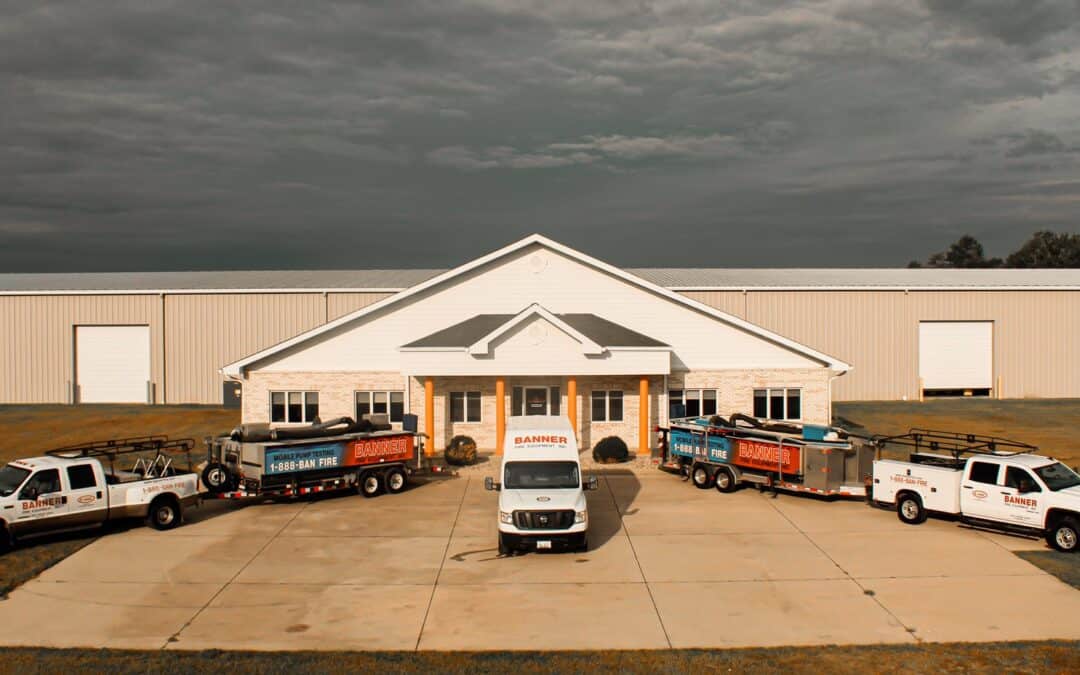
Its first brick-and-mortar location was in Collinsville, Illinois, later moving to Roxana, Illinois. Its recent move, also in Roxana, was into a 39,000-square-foot building. It includes company headquarters, a retail store, and repair facilities capable of holding 30 rigs under one roof.
A second location is in Oklahoma City, Oklahoma. It is a result of the purchase of Chief Fire, explained later herein. Junior says, “The Oklahoma shop is new and growing but has nearly the same capabilities as the Roxana shop, less the paint booth. They have welders and fabrication capabilities just the same. We have not done too much collision repair there yet, but we are ready when something comes in.”
APPARATUS AND AMBULANCES
Banner has always sold the full line of E-ONE apparatus. As of press time, its E-ONE area of responsibility includes the eastern half of Missouri, the lower two thirds of Illinois, Arkansas, Iowa, and Oklahoma. Banner also markets the Fire Master line of tankers, a product E-ONE does not offer. CET-branded products are also sold.
Wheeled Coach and Road Rescue ambulances are sold in Oklahoma. Road Rescue vehicles are also marketed in Arkansas and Missouri. And, Banner now manufactures its own line of brush trucks.
BRIEF Q & A WITH JUNIOR
Describe Banner’s customer base, “More than 75% is volunteer, and the balance is career or combination. We sell most of our apparatus to rural areas and some cities. We currently do not have a large urban/suburban customer base.”
Approximately how many employees?
“We are hovering around 75.”
How many full-timers in apparatus sales?
“Eleven, plus a couple part-timers.”
Do you want to list your “key” employees?
“I have many cherished and valued employees, and I don’t feel it is appropriate to single one or two out as to not take the shine off the others.”
Are all your repair/service people certified?
“We have a variety of experience levels, and most are on EVT paths. They have had rescue tool training, SCBA certs, etc. We try to start new people with pump training because that is what we do best.”
Do you sell used apparatus as a practice?
“No, we sell a used truck here and there.”
Do you have a niche in the market?
“We have a few. We have a large quantity of stock trucks in the backlog, so we can get a customer into a truck without them waiting several years.”
About how many apparatus and ambulances a year do you sell?
“All in, we have more than 140 vehicles on order between all of our brands and in our stock programs.”
How many on-the-road service trucks do you have?
“Five in Roxana and two in Oklahoma City.”
What is the most popular apparatus body material?
“Banner’s preference is aluminum; however, E-ONE’s Hamburg, New York, plant makes a very nice stainless steel product.”
What is the most popular method of construction?
“For popularity throughout the entire marketplace and the amount of VM8 trucks we sell, I would say formed aluminum.”
Do you see a trend for multifunction apparatus such as pumper-tankers and rescue-pumpers?
“I see a trend in availability and price. That and Roto-Rays!”
In the competitive bidding arena, are buyers’ purchasing specifications proprietary, performance-based, or generic (open)?
“Eight out of 10 are proprietary whether the department knows it or not!”
What is the most common paint color/ scheme?
“We order our stock trucks in solid red. It makes it easier to paint half the cab white, black, etc., if necessary. We have the ability to apply a variety of black coatings in house as well.”
Describe your most popular pumper.
“Mostly 1,250- or 1,500-gal- lon-per-minute (gpm) pumps, 750- or 1,000-gallon tanks, Class A foam, large-diameter hose (LDH) equipped, and a mix of side- and top-mounted operator panels. We sell 80% custom chassis with an average of six seats and 20% commercial. I can see that tilting the other way as departments navigate the Cummins engine changes. The popular raised roof height on custom chassis is 12 inches. We’ve only sold one rear-mounted pump.”
Is there a standard pump panel in your marketing area?
“We sell a mix. I usually order one of each in every configuration we have on order. I have found that when showing a top-mount, some departments tell us that the truck would be perfect if it were a side-mount. So, we order both. Arkansas and rural Illinois are running top-mounts, so we have a market for both.
What’s your most popular ladder truck?
“We sell mostly all rear-mount quints, more aerials than platforms. The most popular aerial length is 75 feet; towers are 100 feet. No tillers.”
What’s your most popular tanker (tender)?
“Wet side with 2,000- or 3,000-gallon tanks with 1,250-gpm pumps on two- door or four-door commercial chassis. We haven’t sold any oval tankers.”
What’s your most popular rescue?
“We have been building light rescues out of our Oklahoma facility but don’t sell many walk-in or large-capacity rescues. I believe we last sold one in 2018.”
How would you describe the wildland and ambulance markets in your area?
“I have yet to see a ‘normal’ market for wildland trucks and ambulances.”
CHIEF FIRE
When and why did you purchase Chief Fire?
“In September of 2021. Mike Heilman called and pitched me buying his company on a Thursday. We flew down the following Tuesday to talk brass tacks, and we had a deal by 2 p.m. We closed on the business in less than eight weeks, including real estate. Mike had no heir apparent, and we were in growth mode, so it made sense. We carried a lot of the same lines, so it was a good fit. It was not easy at first, but things have smoothed out.”